
AC Copper Pipe Installation in Karachi
Precision Piping by Karachi Repairs
Most people never think about the copper piping connecting their AC's indoor and outdoor units until something goes wrong — a leak, a cooling drop, or an ugly patch of exposed pipe running across an outside wall. Yet this piping is doing one of the most important jobs in the entire system, carrying refrigerant back and forth between the two units continuously whenever your AC runs. Get the pipe gauge wrong, skip proper insulation, or use a low-quality flare joint, and you'll be dealing with reduced cooling, higher electricity bills, or a slow leak within a year or two.
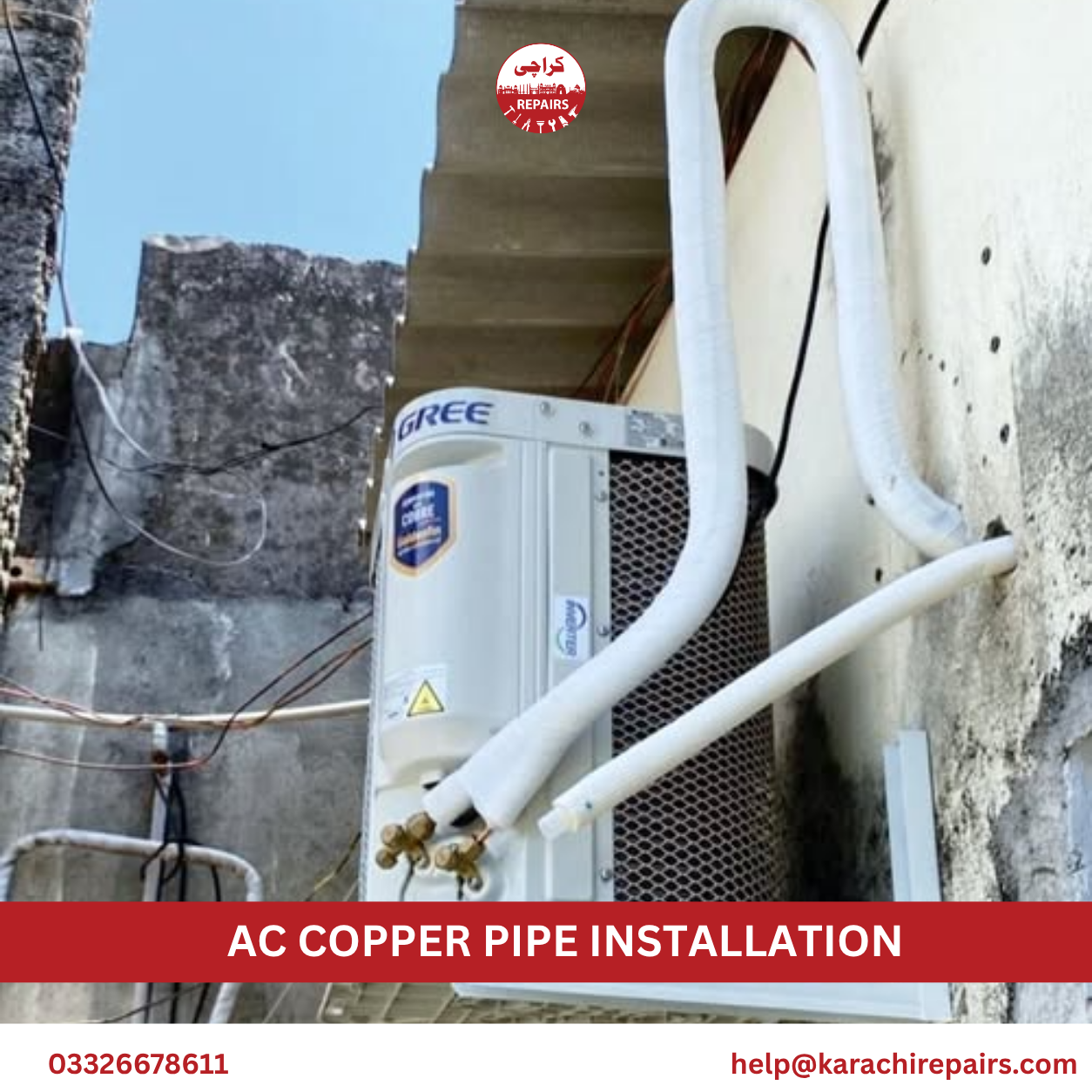
At Karachi Repairs, copper pipe installation is treated as a precision job, not something rushed through with whatever pipe happens to be lying around. Our technicians select the correct pipe gauge for your unit's tonnage, cut and flare joints to proper specification, insulate the full length correctly, and route piping in a way that's both efficient and reasonably tidy on the wall. This page covers everything about our copper piping service — when you need it, what proper installation actually involves, and how to spot the difference between quality work and a rushed job.
AC Copper Pipe Installation is part of our full HVAC Services in Karachi, alongside installation, repair, servicing, gas refilling, and compressor replacement for homes and businesses.
Same-Day Response Piping Service
Need new AC piping installed or old corroded pipes replaced? Tell us the address and the requirement. Our technicians usually reach you within 1 to 2 hours anywhere in Karachi with the right tools and materials.
REQUEST A FREE VISIT / QUOTE


When You Need Copper Pipe
Installation or Replacement
New AC Installation: Every new split, inverter, or ducted AC installation requires fresh copper piping connecting the indoor and outdoor units, cut and fitted specifically for your property's layout and the distance between the two units.
Relocating an Existing Unit: If you're moving your outdoor unit to a different spot, or shifting the indoor unit to another wall during a renovation, new piping is typically needed to match the new routing and distance.
Corroded or Damaged Piping: Karachi's coastal humidity and salty air corrode copper piping over time, particularly on older installations. Once corrosion has progressed far enough, patching isn't reliable, and a full section replacement becomes necessary.
Repeated Leaks at the Same Joint: If a particular joint or section of piping has needed leak repair more than once, it often indicates the piping itself has weakened or was poorly installed initially, making replacement the more sensible long-term fix rather than another temporary patch.
Upgrading From an Old, Undersized System: If you're upgrading to a higher-tonnage unit, the existing piping gauge may not be suitable for the new system's refrigerant flow requirements, making fresh piping a necessary part of the upgrade.
Extending Piping for a New Outdoor Unit Location: Sometimes property layout changes — a new extension, altered balcony access, or a repositioned outdoor unit stand — require extending or rerouting existing piping runs.
Understanding Copper
Pipe Gauge and Sizing
Copper piping for AC systems comes in different diameters, and using the correct size for your unit's tonnage is one of the most important technical decisions in the entire installation.
Why Gauge Matters: Undersized piping restricts refrigerant flow, forcing the compressor to work harder and reducing overall cooling efficiency. Oversized piping, while less common as an issue, can also affect proper refrigerant velocity and oil return to the compressor, which matters for long-term reliability.
Typical Sizing by Tonnage: Manufacturers specify exact liquid and suction line diameters for each unit based on tonnage, and these specifications vary between brands and models. Our technicians always reference the manufacturer's specific requirements rather than using a generic size regardless of the unit installed.
Pipe Thickness and Quality: Beyond diameter, wall thickness matters for durability and pressure handling. Thinner, lower-quality piping is more prone to denting during installation and developing pinhole leaks over time, particularly in Karachi's corrosive coastal air.

How Much Does Copper Pipe Installation Cost in Karachi?
Pricing for copper pipe installation or replacement depends on several factors specific to your situation.
Pipe length required
Longer runs naturally require more copper and more labour time.
Pipe gauge and quality
Larger diameter pipes for higher-tonnage units cost more than standard residential sizing.
Routing complexity
Concealed piping through walls or ceilings takes longer than straightforward exposed external routing.
Number of joints required
More complex routes with bends and multiple connection points add to labour time.
New installation or replacement
Replacement work often involves removing old, sometimes deteriorated piping first, adding to the overall job.
Call 0332-6678611 and describe your situation — whether it's part of a new AC installation, a relocation, or replacing corroded piping — and we'll give you a clear estimate before booking a technician visit.
Insulated vs Non-Insulated Piping
Why It's Not Optional
Some cheaper installation jobs skip proper insulation on parts of the pipe run to save time and material cost, particularly on sections that will be hidden behind trunking or inside a wall cavity where nobody will see it. This is a mistake that costs the customer far more over time than it saved during installation.
Without proper insulation, the suction line — which carries cold refrigerant gas back to the compressor — picks up ambient heat along its entire uninsulated length, especially in Karachi's hot climate. This reduces overall system efficiency, forces the compressor to work harder, and can lead to condensation forming on the pipe itself, which over time causes moisture damage to surrounding walls or ceiling material. Proper insulation isn't a cosmetic extra; it's a functional requirement for the system to perform as designed.
Concealed vs Exposed Piping
Planning It Right From the Start
Many homeowners in Karachi, particularly in newer construction or during renovations, prefer copper piping concealed within walls or false ceilings for a cleaner aesthetic rather than visible pipe runs with external trunking. Both approaches are valid, but concealed piping requires more careful planning since accessing it later for a leak repair becomes significantly more difficult.
If you're planning concealed piping, we recommend using slightly higher-quality, properly rated copper and ensuring joints are minimised and well-tested before the wall or ceiling is finished, since undoing finished wall work to reach a leaking joint later is far more disruptive and costly than a similar repair on exposed piping. Our technicians will discuss this trade-off with you honestly if you're planning new construction or a major renovation involving concealed AC piping.
Signs Your Existing Copper Piping Needs Attention
If you're noticing any of these, it's worth getting the piping inspected before it leads to a bigger cooling issue or, in the case of wall penetration leaks, water damage to your property.
Corrosion Staining
Visible green or blue-green corrosion staining on the copper surface, particularly common in coastal humidity.
Damaged Insulation
Insulation that's cracked, peeling, or missing along sections of the exposed pipe.
Ice on Piping
Ice forming on the piping itself rather than just inside the indoor unit, often indicating an insulation gap or refrigerant issue.
Hissing Sounds
A hissing sound near a specific section of piping, suggesting an active leak.
Dents or Kinks
Visible dents or kinks in the pipe, which restrict refrigerant flow and can eventually crack under continued pressure.
Water Stains on Wall
Water stains on the wall where piping passes through, indicating poor sealing at the penetration point.
What Makes Karachi Repairs Different For Copper Pipe Work
Correct Sizing Every Time
We reference manufacturer specifications for your specific unit rather than defaulting to a generic pipe size, ensuring optimal refrigerant flow and system efficiency.
Quality Copper
We use properly rated copper piping with adequate wall thickness, rather than the thinnest, cheapest tubing available, which tends to dent easily and corrode faster in Karachi's coastal climate.
Proper Flaring and Torquing
Every joint is flared correctly and torqued to specification, since this is the single most common point of failure in poorly done piping work.
Full-Length Insulation
We insulate the complete pipe run, including sections hidden behind walls or trunking, rather than only insulating the visible portions that are easy to access.
Leak Testing Before Charging
Every new pipe installation is pressure tested for leaks before any refrigerant is introduced into the system, catching issues before they become an expensive problem later.
Neat, Weatherproofed Routing
Where piping runs externally, we use proper PVC trunking or clips to keep the installation tidy and protected from direct weather exposure, rather than leaving bare, exposed pipe runs along your walls.
Important Piping Considerations
How Piping Length Affects Performance
A common misconception is that pipe length doesn't matter much as long as the pipe connects both units. In reality, longer pipe runs mean more surface area for heat gain, more potential for refrigerant oil separation issues, and in some cases, may require adjusted refrigerant charge amounts to compensate for the additional pipe volume. Manufacturers typically specify a maximum recommended pipe length for each unit, beyond which cooling efficiency starts to noticeably decline, and installation may require additional considerations like extra refrigerant or, in some cases, additional support equipment. If your property layout requires an unusually long piping run between the indoor and outdoor units, it's worth discussing this with our technician during the site assessment so the installation is planned correctly from the start rather than dealing with underperformance after the fact.
Larger Installation vs a Standalone Job
Copper piping work is often just one part of a full AC installation, bundled in with mounting, electrical connection, and gas charging as a complete package. However, we also handle standalone piping jobs — replacing a corroded section on an existing unit, extending a run after relocating the outdoor unit, or fixing a poorly routed installation from a previous job done by someone else. If you're dealing with a standalone piping issue on an otherwise functioning AC, there's no need to treat it as a full reinstallation. Our technician assesses exactly what section needs attention and addresses that specific part of the system rather than unnecessarily redoing work that's already functioning properly.
Brazing vs Flaring
There are two main ways of joining copper pipe sections in AC installations. Flaring involves shaping the end of the pipe into a cone shape that seats against a matching fitting, secured with a nut. This is the standard method used for connecting piping to the indoor and outdoor unit service valves. Brazing involves heating copper pipe sections and joining them with a filler metal to create a permanent, soldered connection. This method is generally used for joining longer straight pipe runs or connecting multiple sections together, particularly on larger commercial or ducted systems. Our technicians choose the appropriate method for each specific connection point based on standard practice and your system's requirements.
What Happens During Karachi's Monsoon Season
Karachi's monsoon months bring a different kind of stress on external copper piping and its surrounding seals compared to the rest of the year. Water can find its way into poorly sealed wall penetrations where piping passes from indoor to outdoor units, and prolonged dampness around external piping accelerates the very corrosion process that eventually leads to leaks. Proper installation accounts for this by using weatherproof sealant at wall penetration points and ensuring insulation on exposed sections is rated to handle repeated wet-dry cycles. If your existing piping installation predates proper weatherproofing standards, or if you've noticed water stains near where the pipe enters your wall after monsoon season, it's worth having that specific point checked and resealed properly.
Our Copper Pipe Installation Process
Step by Step
Step 1 – Route Planning
Before any cutting begins, our technician plans the most efficient and structurally sound route between the indoor and outdoor units, minimising unnecessary bends and length while keeping the routing as tidy as possible against your wall or ceiling.
Step 2 – Cutting to Correct Length
Pipe is cut to the precise length needed for the planned route, avoiding both wasteful excess coiled pipe and pipe that's too short and under tension at the joints.
Step 3 – Flaring the Pipe Ends
Each pipe end that connects to the indoor or outdoor unit is flared using a proper flaring tool to create a clean, even seal at the connection point. A poorly flared end is one of the most common causes of refrigerant leaks at joints.
Step 4 – Connecting and Torquing Joints
Flared connections are tightened to the correct torque specification, since both under-tightening and over-tightening can create leak points, either through insufficient sealing pressure or through damage to the flare itself.
Step 5 – Insulating the Full Pipe Length
The suction line, and sometimes the liquid line depending on climate conditions, is wrapped with proper closed-cell foam insulation along its entire length, including sections that will be hidden inside walls or behind trunking.
Step 6 – Securing and Routing
Piping is properly clipped and secured along its route to prevent sagging, vibration damage, or stress on the joints over time, with wall penetrations sealed to prevent water ingress.
Step 7 – Vacuuming and Leak Testing
Before the system is charged with refrigerant, the entire pipe run is vacuumed to remove air and moisture, and pressure tested to confirm there are no leaks at any of the newly made joints.
Step 8 – Gas Charging and Final Testing
Once the piping passes leak testing, the system is charged with the correct refrigerant and run through a full test cycle to confirm proper cooling performance.
Copper Piping and Karachi's Building Types
Karachi's mix of building styles — from older bungalows with thick masonry walls to modern high-rise apartments with concrete and glass facades — each present slightly different piping considerations.
Older Bungalows and Independent Houses: These often have more flexibility for external piping routes along walls or through gardens, but older buildings sometimes have wall materials that require more careful drilling to avoid existing electrical wiring or plumbing already embedded in the structure.
Apartment Buildings and High-Rises: Piping routes here are often more constrained, running through designated service ducts or along balcony exteriors, and outdoor unit placement is frequently dictated by building design rather than free choice, which our technicians work around during route planning.
Commercial and Office Buildings: These often involve longer piping runs to reach centrally located outdoor units or rooftop condenser areas, sometimes requiring additional support brackets and more extensive insulation given the greater distances involved.
DIY Piping Fixes vs Calling a Professional
We occasionally see customers who've attempted to patch a small piping issue themselves, usually with tape or a generic sealant, before calling us once it clearly hasn't worked. Refrigerant lines operate under pressure, and any general-purpose tape or sealant not specifically designed for refrigerant piping will not hold a proper seal against that pressure for long, if at all.
Beyond the sealing issue, working with refrigerant lines involves handling pressurised gas, which carries genuine safety risks if released improperly, and any DIY attempt at cutting, flaring, or rejoining copper pipe without the correct tools usually results in a connection that leaks worse than before, sometimes damaging the pipe end enough that a larger section needs replacing instead of just the original small leak point.
If you notice a hissing sound, visible pipe damage, or ice forming along a section of piping, the safest and most cost-effective step is to call a technician directly rather than attempting a temporary fix that's likely to fail and could end up costing more to properly repair afterward.
Book Your AC Copper Pipe Installation With Karachi Repairs Today
Copper piping is one of those parts of an AC system that only gets attention when something's already gone wrong, but doing it correctly from the start saves you from leaks, inefficiency, and expensive repairs down the line. Our teams are positioned across Karachi so we can reach you quickly, install or replace your piping to proper specification, and test everything thoroughly before we consider the job done.
Call or WhatsApp us now at 0332-6678611, or explore our complete range of HVAC Services for installation, repair, servicing, and gas refilling.

Areas We Cover Across Karachi
Karachi Repairs provides copper pipe installation and replacement services across the city, including but not limited to Clifton, DHA (all phases), Gulshan-e-Iqbal, Gulistan-e-Johar, North Nazimabad, Nazimabad, Federal B Area, PECHS, Bahadurabad, Malir, Korangi, Landhi, Saddar, Garden, North Karachi, Shah Faisal Colony, and surrounding neighbourhoods. If you're unsure whether we cover your specific area, call us and we'll confirm coverage along with the expected arrival time of our nearest team.
Frequently Asked Questions About AC Copper Pipe Installation
How fast can Karachi Repairs reach my location for copper pipe work?
We maintain teams stationed across different areas of Karachi, so in most cases our nearest available technician can reach you within 30 minutes of your call, depending on your exact location and time of day.
Why does copper pipe gauge matter for my AC's performance?
Using the correct pipe diameter as specified by the manufacturer ensures proper refrigerant flow and pressure. Undersized piping restricts flow and reduces cooling efficiency, while incorrect sizing can also affect long-term compressor reliability.
Do you replace old, corroded copper piping?
Yes, we assess existing piping for corrosion, dents, or repeated leak points and replace affected sections with properly rated new copper, matched to your unit's specifications.
Is insulation really necessary on the entire pipe length?
Yes, insulating the full pipe run, including sections hidden behind walls or trunking, prevents heat gain, reduces electricity consumption, and avoids condensation-related moisture damage.
Can you install concealed copper piping inside walls or ceilings?
Yes, we handle concealed piping installations, though we recommend minimising joints and thoroughly leak testing before any wall or ceiling finishing work is completed, since access becomes harder afterward.
How long does copper pipe installation take?
A standard piping installation as part of a new AC setup typically takes a couple of hours, while standalone replacement of an existing damaged section can often be completed within a similar timeframe depending on accessibility.
Does longer piping affect my AC's cooling performance?
Yes, longer pipe runs increase potential heat gain and may require adjusted refrigerant charge. Our technician accounts for pipe length during installation to keep performance within expected levels.
Do you offer copper piping work for commercial and multi-unit properties?
Yes, we handle copper pipe installation and replacement for homes, offices, restaurants, and commercial properties across Karachi, including multi-unit ducted systems requiring more extensive piping networks.
Areas We Cover
Across Karachi
Our technicians are spread across the city rather than run from one workshop, which is how same-day response stays possible in Karachi traffic.