
Solar Onsite
Consultation in Karachi
Most people who want solar start the same way. They ask a neighbour, call two or three shops and collect quotes. The quotes never match. One says 5 kW, another says 10 kW. One includes batteries, another does not. Nobody has even seen the roof. At the end, you still do not know what your house actually needs.
An onsite consultation fixes this. A Karachi Repairs engineer visits your property, looks at your roof, your wiring, your meter and your appliances, and tells you what makes sense. No guessing from a phone call. This page is part of our wider solar system services in Karachi.
To book a visit, call us on 03326678611. To know what happens during one, keep reading.

What Is a Solar Onsite Consultation?
It is a site visit by a trained engineer before you buy or change anything. He checks your property in person and gathers the facts a proper solar design needs. Then he explains the findings, answers your questions and recommends a plan.
The visit is useful in several situations.
- You want to install solar for the first time and do not know where to start
- You already have quotes and want a second opinion
- Your existing system is not performing as it should
- You plan to add panels, batteries or a bigger inverter
- You are building a new house and want to plan solar from the start
- You run a shop, clinic, office or workshop and want to cut your bills
- You want to switch from tubular to lithium batteries
- Your solar system was installed years ago and nobody has checked it since
Think of it as a medical check-up for your electrical setup. The engineer finds out what you have, what you need and what stands between the two.
REQUEST A FREE VISIT
What Our Engineer Checks
During the Visit
Every visit follows a clear checklist. This keeps the advice consistent and nothing gets missed.
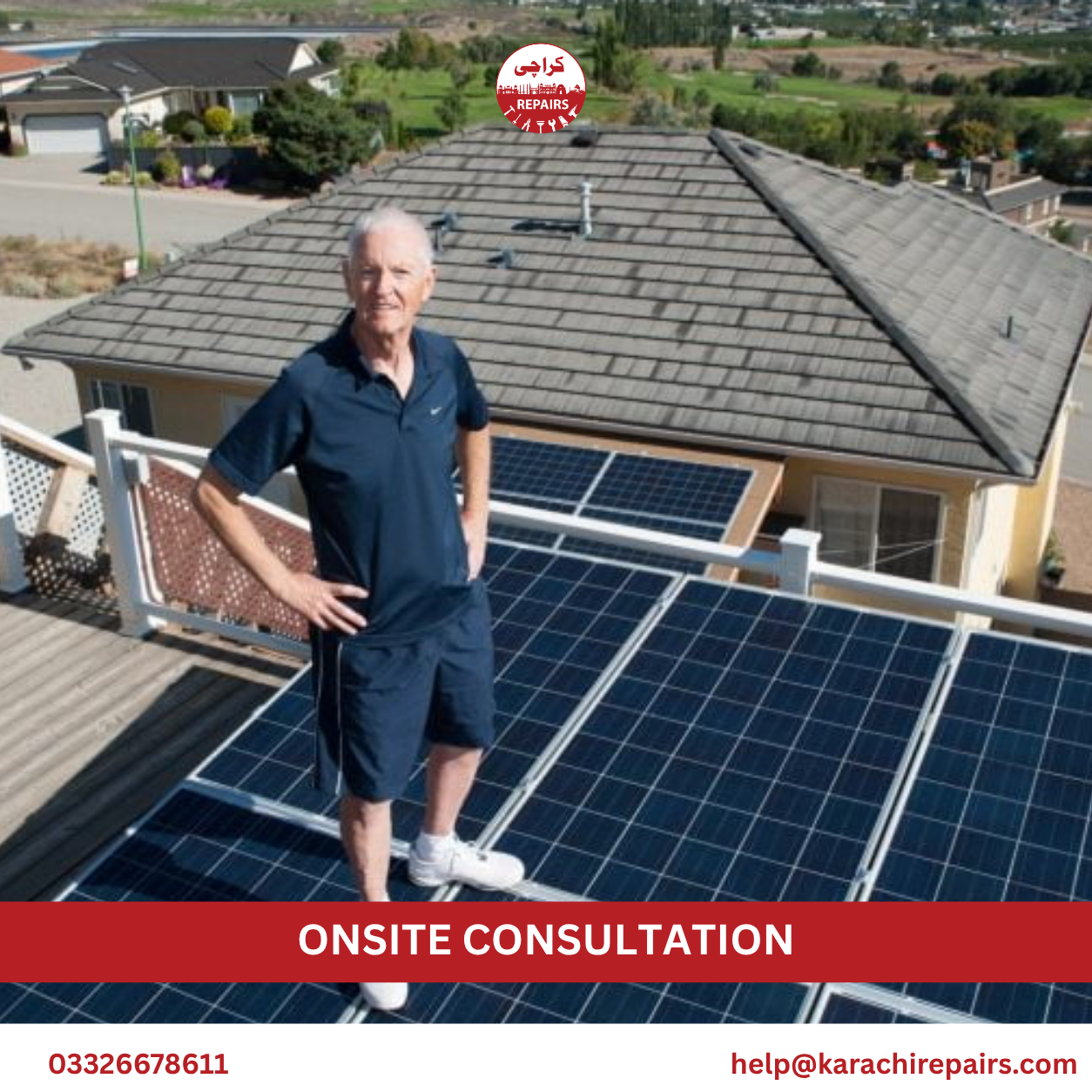
1. The Roof and Open Space: He measures the free area and checks the type of roof. A flat RCC roof, a sloped roof and a metal sheet roof each need a different mounting method. He also looks at the roof's condition, access points and the safest way to bring equipment up.
2. Shading and Sun Exposure: He notes the nearby buildings, trees, water tanks and rooftop structures. He thinks about how shadows move through the day and across the seasons. Winter shadows are longer, so a roof that looks clear in summer may be shaded in December.
3. Electricity Meter and Connection: He checks whether you have a single-phase or three-phase connection, your sanctioned load and the condition of the meter and main board. This decides which type of inverter can be used.
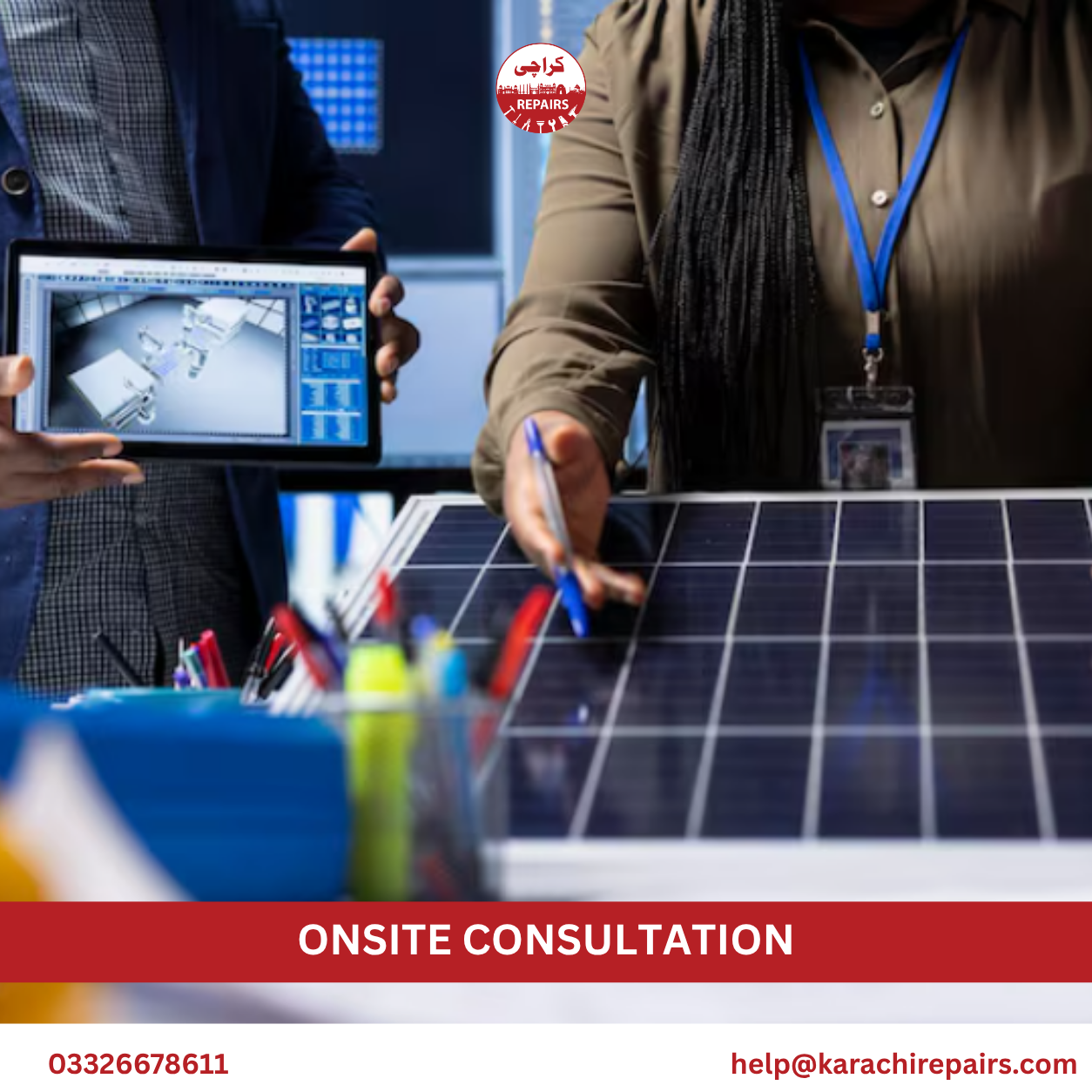
4. Electricity Bills: Please keep your last six to twelve bills ready. They show your average monthly units and how your use changes between summer and winter. This helps us estimate system size without guessing.
5. Appliance Load: He lists your major appliances, their wattage and how long you run them. ACs, water pumps, refrigerators, irons, microwaves and washing machines all affect inverter size. He also asks about future plans, such as adding an AC or an electric vehicle charger.
6. Existing Wiring and Distribution Board: He looks at cable sizes, breakers and the state of the distribution board. Loose joints, burnt marks, overloaded circuits and missing protection are all noted.
Choosing Between On-Grid,
Off-Grid and Hybrid
This is the biggest decision in any solar project, and the site visit makes it much easier. Here is a plain summary of each type.
On-grid. Works alongside K-Electric, needs no batteries and costs less at the start. It switches off when the grid fails, which is a safety rule. Good for shops and homes with steady supply that mainly want lower daytime bills.
Off-grid. Runs on panels and batteries with no grid connection. It suits farmhouses, remote sites and plots with no reliable supply. It needs a large battery bank.
Hybrid. Combines both. It charges batteries from solar, runs the house, uses the grid when needed and keeps working during a power cut. Most Karachi homes with regular load shedding choose this.
During the visit, we match one of these to your real situation. A home that loses power twice a week needs a different plan from a home that loses it twice a day. We look at your area, your habits and your budget before recommending.
Sizing the System Properly
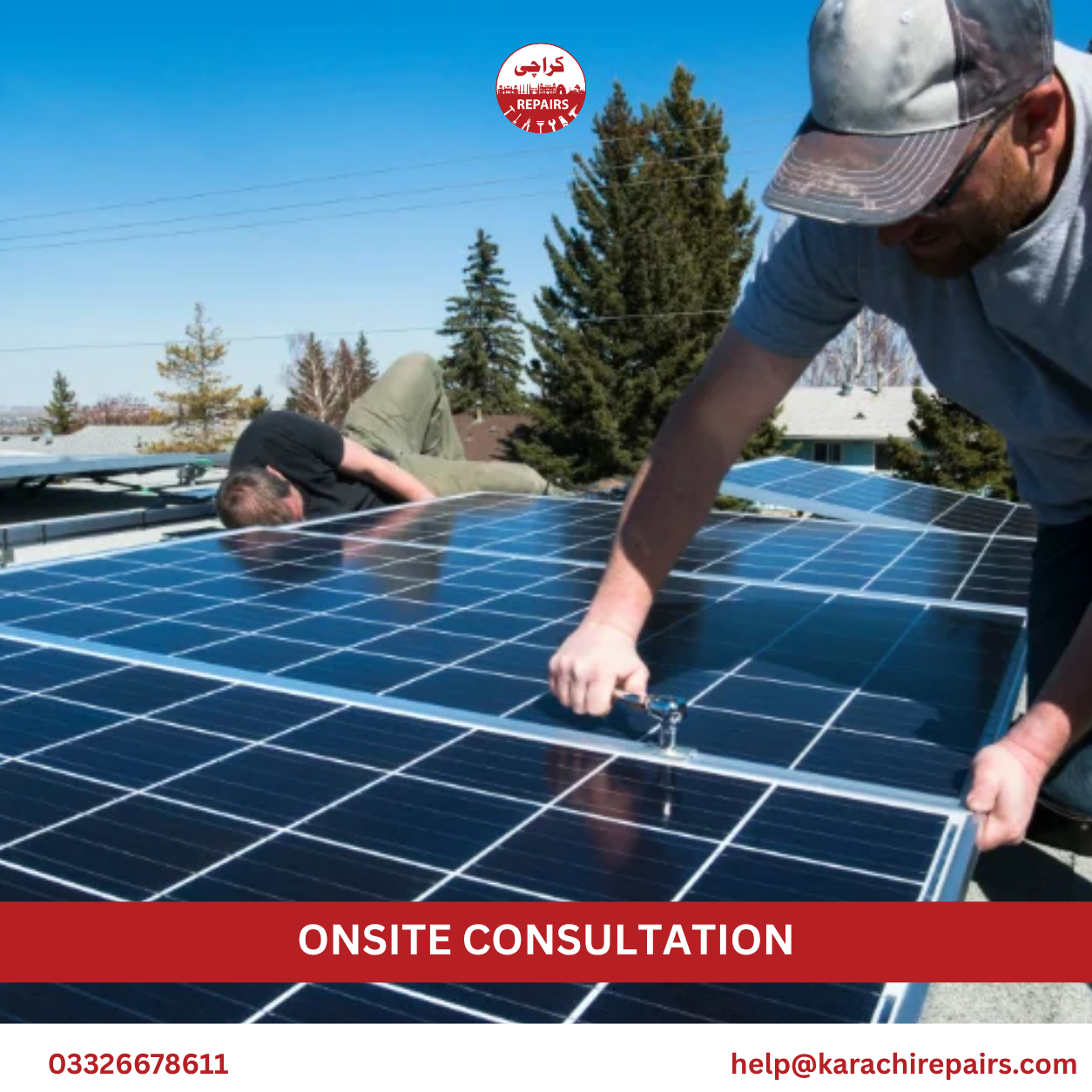
System sizing is where most mistakes begin. People buy by price per kilowatt, or copy a neighbour's setup. Neither works well, because each house is different. We size three parts together: the panels, the inverter and the battery bank.
Panels
Panel count depends on your units, your roof area and your goal. If the roof is small, we may recommend higher-wattage panels to get more power in the same space. If the bill is the main goal, we focus on daytime generation.
Inverter
The inverter must handle your running load and the starting surge of motor appliances like ACs and pumps. An inverter that is too small trips often. One that is far too large wastes money.
Battery Bank
Battery size depends on what you want to run during an outage and for how many hours. A bank sized for fans, lights and a fridge is very different from one sized for several ACs. We also compare tubular and lithium options.
Reading Your Electricity Bill Together
Your bill holds more information than most people notice. During the visit, our engineer goes through it with you line by line, because it shapes the whole design.
Monthly Units
He looks at your monthly units first. A home that uses 300 units a month needs a very different system from one that uses 1,000. Next, he compares months. Summer bills in Karachi usually jump because of ACs, and winter bills drop. A good system is sized with both in mind.
Tariff Slab
Electricity prices rise in steps as your units go up. Cutting your use by a few hundred units can bring you down a slab and reduce your per-unit rate, which makes the savings bigger than the units alone suggest. Tariffs and charges change from time to time, so we use the figures on your latest bills, not old numbers.
Usage Timing
Finally, he asks when you use power. If most of your load runs in the afternoon, solar helps a lot. If most of it runs at night, batteries become more important. This timing decides how much of your solar output you actually use directly.
Consultation for Homes,
Shops and Factories
The checklist is similar, but each type of property needs a different focus.
Homes. We focus on roof space, daytime and evening load, backup needs and the safest place for batteries. Flats and shared buildings need extra care, because roof access and permission may be limited.
Shops, clinics and offices. These run during daylight, so solar suits them well. We look closely at ACs, freezers, computers and lighting, and at whether the supply is single-phase or three-phase. Uptime often matters more than savings, so backup design gets attention.
Factories and workshops. Heavy machines have large starting currents, and loads often run on three phases. We check cable sizes, the main distribution board and any existing generator arrangement. The roof structure must also carry the weight of a large array.
If you rent the property, tell us. The owner's permission and the ability to remove the system later are part of the plan.
Planning Upgrades
and Expansion
Needs change. You add an AC, a family member moves in or a new floor goes up. A consultation helps you plan the next step without wasting what you already own.
Common upgrade questions we answer include:
- Can I add more panels to my current inverter?
- Is my inverter big enough for another AC?
- Should I move from tubular to lithium batteries?
- Does my DB panel have proper protection for a larger system?
- Can I shift the system to a new roof or a new house?
- Should I switch from on-grid to hybrid?
For each of these, the engineer checks compatibility first. Many inverters have limits on panel input and battery type. Knowing those limits before you buy saves money and avoids disappointment. For more on our related work, see the solar systems page.
Reviewing an Existing Solar System
An onsite consultation is not only for new installations. Many people call us because their current system is not doing what they expected. Maybe the bill has not dropped. Maybe the batteries run out too fast. Maybe the inverter shows errors again and again. In such cases, the engineer reviews what is already installed.
Panel Condition
He checks the panels for dirt, shading, cracks and damaged connectors
String Output
He measures string voltage and current to see if the array is producing what it should
Inverter Status
He reads the inverter display and fault history
Battery Testing
He tests the batteries and looks at terminals and cables
Settings Check
He checks inverter settings, such as grid priority and charge limits
Protection
He inspects breakers, earthing and surge protection
Load Matching
He looks at whether the system size still matches your current load
After the review, he explains what he found in plain words. Sometimes the fix is simple, such as a loose terminal or a wrong setting. Sometimes the system has simply outgrown your needs. Either way, you leave with a clear picture and a list of options.
Why Choose Karachi Repairs For Your Consultation
You have many people offering solar advice in this city. Here is what we focus on.
We Look Before We Quote
We check your roof, wiring, load and bills first. Our recommendation comes from facts, not from a standard package.
We Give Honest Advice
If you need a smaller system, we say so. If your existing system can be fixed, we say that too. We do not push what you do not need.
We Think About Safety
We report risks in wiring, earthing and protection, even when they were not part of your request.
We Explain in Plain Words
You get clear answers without jargon. If something is uncertain, we tell you it is uncertain.
We Put It in Writing
Every quote lists equipment, ratings, labour and extras. You can compare it with any other offer.
We Stay Reachable
Questions after the visit are welcome. Call us any time, and we will help.
Common Solar Myths We Clear Up on Site
Many customers arrive with ideas they picked up from friends or videos. Some are true. Some are not. Here are the ones we hear most. Clearing these up early prevents bad purchases. We would rather you decide with correct facts, even if the facts mean spending less.
"A bigger system is always better."
Not true. An oversized system wastes money if your roof, load and inverter cannot use the extra power.
"Solar works only in full sun."
Panels still generate on cloudy days, just at a lower level.
"I can run any number of ACs with any inverter."
The inverter must handle the starting surge of every compressor, so capacity matters.
"Solar needs no maintenance."
Panels need cleaning, and the wiring and batteries need occasional checks.
"Lithium is always the better choice."
It lasts longer, but it suits some homes more than others, depending on daily use and budget.
"The cheapest quote is the best deal."
A low price often hides thin cables, missing protection or low-grade equipment.
"My system will pay for itself in a year."
Payback depends on your bills, system size and use. We do not promise a fixed period.
Safety Issues We Often Find During Visits
Some visits reveal problems the owner did not know about. We always report them, even when they are not part of the work you asked for. Here are the ones we see most.
Safety Risks to Look Out For
No DC isolator.
Nobody can switch the panels off safely for service.
Wrong breakers.
AC breakers used on DC lines, which can fail to cut a DC arc.
Thin cables.
Wires that heat up under load and may start a fire.
No earthing or a weak earth.
Surges and faults have nowhere safe to go.
Loose or taped joints.
They heat up and cause sparking.
Batteries in closed cupboards.
Heat and gas build up with no airflow.
Unlabelled boards.
No one knows which breaker controls what.
Damaged panel connectors.
Sun and weather wear out poor-quality plugs.
We would rather tell you about a risk than keep quiet because it does not suit a sale. A short list of fixes now can prevent a costly failure later.
How to Prepare for the Visit
A little preparation makes the visit faster and the advice more accurate. Here is what to have ready.
If you cannot be present, a trusted family member can let the engineer in. Please make sure someone can explain how you use electricity at home.
How Long Does an Onsite Consultation Take?
Questions to Ask Any Solar Company During a Visit
Even if you do not choose us, you should know what a good consultation looks like. Here are questions worth asking any company.
- How did you decide on this system size?
- What brand and model are the panels, inverter and batteries, and where is their warranty support in Pakistan?
- What protection devices and earthing are included in the quote?
- How will you fix the structure to my roof, and how do you prevent leaks?
- How long will installation take?
- What happens if something fails after installation?
- What is not included in this price?
A confident, honest company answers these without hesitation. If the answers are vague, take that as a warning.
What Happens After the Consultation
You decide what comes next. Some customers approve the plan within a day. Others take a week to compare quotes. Some decide to wait and build in stages. All of these are fine.
If you choose to go ahead with us, we schedule the work around your availability. We then handle the installation, protection, earthing and testing, and walk you through the finished system. If you choose a different provider, you still keep the information we gave you.
If you want to start in stages, we can help with that too. For example, you might begin with a hybrid inverter and a small battery, then add panels and more batteries later. The design should leave room for it, so you do not need to replace equipment as you grow.

Book Your Solar Onsite Consultation Today
A good solar system starts with good information. Ten minutes on a roof with a trained engineer can save you years of poor output and expensive corrections. A guess over the phone cannot do that.
Call Karachi Repairs on 03326678611, tell us your area and what you want from solar, and we will arrange a visit at a time that suits you. You can also explore our other solar services in Karachi if you already know you need an inverter, panels, batteries or protection work.
One call is enough. Our team will take it from there.
Frequently Asked Questions About Solar Onsite Consultation
The questions our Karachi customers ask most often, answered plainly.
What happens during a solar onsite consultation?
An engineer visits your property, checks your roof, shading, meter, wiring, appliances and bills, and then recommends a suitable system. You receive a written quotation and honest answers to your questions.
How long does the visit take?
Most home visits take about forty-five minutes to an hour and a half. Larger properties, three-phase sites and reviews of existing systems can take longer.
What should I keep ready for the visit?
Your last six to twelve electricity bills, a list of your main appliances, roof and meter access, and any papers for existing solar equipment. A rough budget and your goals also help.
Can you review my existing solar system?
Yes. We check the panels, inverter, batteries, wiring and settings, and explain why the system may be underperforming. We then suggest the simplest fix.
Do I need to be at home during the visit?
It is best if you are, so you can explain how you use electricity. If you cannot be there, a trusted family member can let the engineer in and answer basic questions.
Will you recommend batteries or not?
Only if they suit your needs. If you have little load shedding, an on-grid system may be enough. If outages are frequent, a hybrid system with batteries makes more sense.
Can I get a quote for lithium batteries during the visit?
Yes. We check whether your inverter supports lithium and recommend a battery bank size. We also explain the cost difference compared with tubular batteries.
Am I forced to buy after the consultation?
No. You receive a written quote and can take your time. There is no pressure to decide on the spot.
Do you visit shops, offices and factories?
Yes. We assess homes, shops, clinics, offices and workshops. Commercial sites often need three-phase planning and a closer look at daytime load.
Can you help if I am building a new house?
Yes. It is better to plan solar early. We can advise on roof layout, cable routes, inverter location and earthing before construction finishes.
How fast can your team reach me?
Karachi Repairs has teams in different areas of Karachi. In most covered areas, a team can reach you within 30 minutes of your call, depending on traffic and road conditions.
Karachi Repairs Teams Near You:
Reach Within 30 Minutes
Waiting a week for someone to look at your roof is frustrating. That is why Karachi Repairs keeps teams stationed in different areas of Karachi. When you call, we send the nearest one. In most covered areas, they can reach you within 30 minutes.
Our teams work across these areas and the neighbourhoods around them:
- DHA, Clifton and Defence Phases
- Gulshan-e-Iqbal, Gulistan-e-Johar and Scheme 33
- North Nazimabad, Nazimabad and North Karachi
- PECHS, Bahadurabad and Tariq Road
- Saddar, Garden and Lyari
- Korangi, Landhi and Malir
- Federal B Area, Liaquatabad and Shah Faisal
- Bahria Town Karachi and nearby societies
Traffic, weather and road closures can shift arrival times a little. For urgent calls, such as a system with a burning smell or a tripping breaker, we send the nearest team first. For planned consultations, you can choose a time that suits you.
Not sure whether we cover your street? Call 03326678611, tell us your area and we will confirm right away.