
Antique Watch Repair
in Karachi
Antique watch repair deals with timepieces that are often a century old or more, built with methods and materials that modern watchmaking left behind long ago. These are not simply old watches. Many were made by hand before mass production existed, and each one deserves a repairer who understands how different that era of watchmaking really was.
Karachi Repairs handles antique pocket watches, early wristwatches and other historic timepieces for collectors, museums, families and anyone who has come across a genuinely old piece. This service falls under our watch repair service, so the same team that handles daily repairs also takes on the slower, more careful work that antiques require.
This page explains what makes antique watches different, the common problems we see and how we approach repairing them. If you have a piece you would like assessed, call 03326678611.
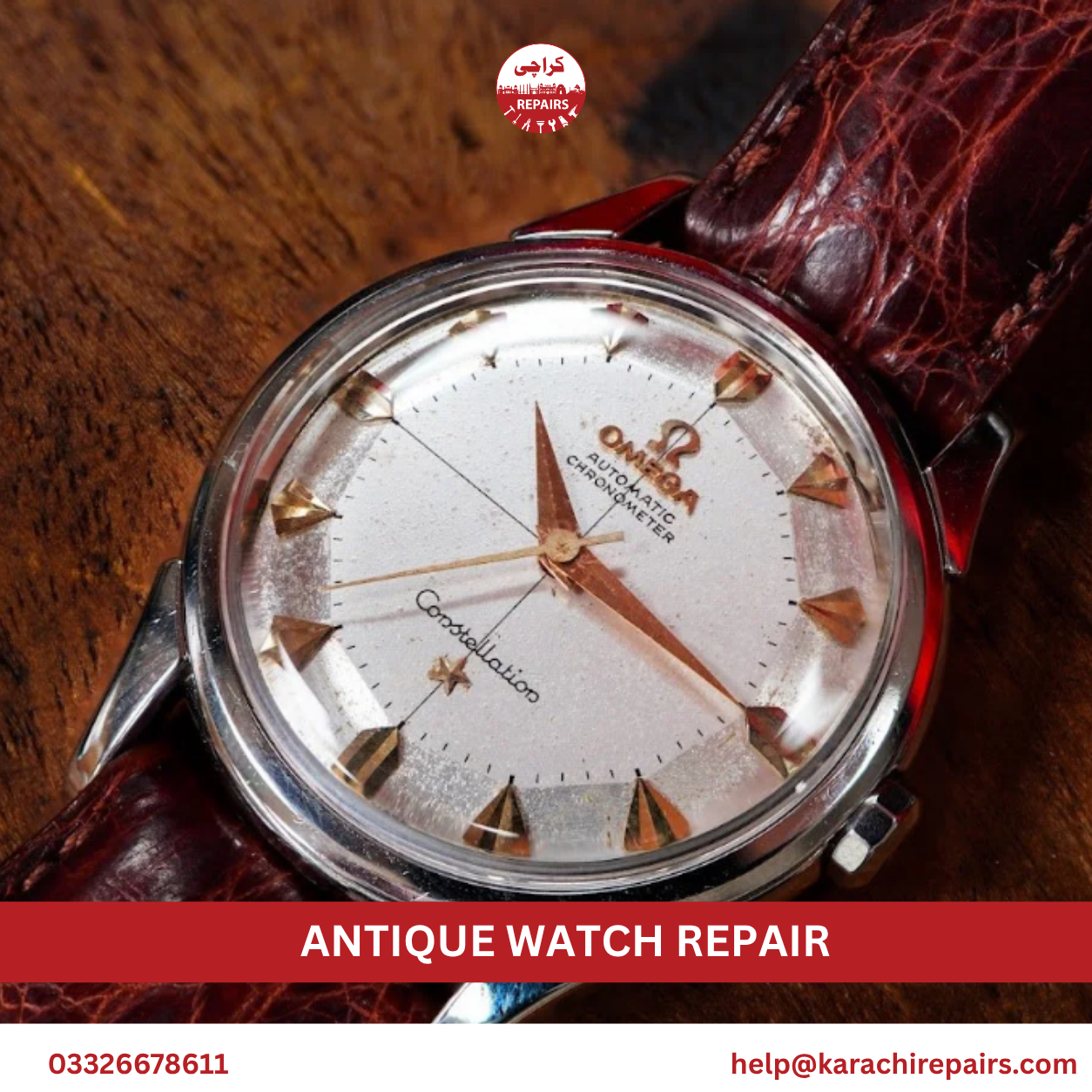
What to Expect When You Bring In an Antique Piece
When you first bring an antique watch to us, we take time to document its condition together with you, noting the case, dial, hands and any visible wear before we open anything. This gives both sides a clear record and avoids any confusion later about what has changed.
We will also ask honest questions about your goals, since these shape the entire repair. There is no single correct answer here, and we would rather understand what matters to you than assume. Once we agree on the approach, we give you a realistic sense of timeline and cost, understanding that antique work sometimes reveals additional issues once the movement is opened that were not visible from the outside.
REQUEST A FREE VISIT


Why Antique Watches
Demand a Different Approach
Repairing a watch built well over a century ago is not the same task as servicing something from the 1980s. Several factors set antique work apart.
Hand-Made Construction: Many antique movements were finished by hand, with individual parts fitted specifically to one watch. A part from a similar watch may look identical but not actually fit correctly, since tolerances were not standardised the way they are today.
Obsolete Mechanisms: Fusee movements, verge escapements and other early designs work on different principles than the lever escapement used in most watches made after the mid-1800s. A technician trained only on modern movements may not recognise how these older systems function.
Fragile Materials: Old steel components can be brittle after a century of temperature changes and handling. Cases made from silver, early gold alloys or gun metal behave differently than modern metals under polishing or pressure.
Historical and Cultural Value: Some antique watches carry real historical significance, whether through their maker, their age or their connection to a particular period or family history. Repair decisions on these pieces need extra thought, since damage cannot always be undone.
Extremely Limited Parts Availability: Original parts for antique movements are usually not available new anywhere. Repair almost always means fixing, adapting or hand-fabricating a replacement rather than ordering one.
Key-Wind, Key-Set
And Enamel Dial Care
Many antique pocket watches use a separate key for winding and setting the time, rather than a crown. These keys are often lost over the decades, and the winding and setting mechanisms need careful handling since they were not designed with the same wear tolerances as later crown-based systems. If your antique watch is missing its original key, we can often source or fit a suitable replacement. We check the winding arbor and setting mechanism carefully before use, since forcing a key into a worn or damaged fitting can cause further harm.
Enamel dials are one of the most beautiful features of many antique watches, and also one of the most delicate. Unlike painted or printed dials, enamel is essentially a layer of glass fused onto a metal base, which makes it hard-wearing against scratches but brittle against impact. Hairline cracks in enamel, sometimes called crazing, are common on older pieces and are generally considered part of the watch's character rather than a defect that needs fixing. We do not attempt to fill or repaint enamel cracks, since doing so incorrectly can cause more visible damage than leaving them as they are. If a dial has significant chipping or a section is missing, we discuss the options honestly, since proper enamel dial restoration is a specialised skill that not every repair can achieve invisibly.

Antique Case Materials and Their Care
Antique watch cases were made from a wider range of materials than modern watches typically use.
Sterling Silver
Common in many antique pocket watches, silver tarnishes over time and needs gentle, careful cleaning rather than aggressive polishing, which can wear down engraved decoration or hallmarks.
Gold and Gold-Filled Cases
Solid gold cases from this era can be polished with care, similar to modern gold. Gold-filled cases have a layer of gold bonded to a base metal, and this layer can be thin after a century of wear, so we approach these cases cautiously.
Gun Metal and Base Metal
Less expensive antique watches often used gun metal or other base metal cases. These can develop their own patina over time, which many owners choose to preserve rather than polish away.
Hallmarks Preservation
Many antique cases carry hallmarks that indicate metal purity, maker and sometimes date of manufacture. These marks add historical and sometimes financial value, so we take care not to polish or handle the case in a way that would wear them down or obscure them.
Preservation
As the Guiding Principle
With antique watches, we lean strongly toward preservation over restoration, more so than with newer vintage pieces. A century-old watch's value, both financial and historical, often depends heavily on how much of its original material and character remains intact.
This means we generally avoid replacing an original dial unless it is severely damaged, avoid case polishing that would remove original hallmarks or engraving, keep original hands, crystal shape and other details wherever functionally possible, and explain clearly when a repair choice involves a trade-off between function and originality. Our goal is always to make the decision yours, with full information about what each choice means for the piece.
Common Antique Watch Problems We Address
Antique watches tend to develop issues shaped by their age and original construction. These are the ones we encounter most.
Seized or Sluggish Movement
Century-old lubrication does not just dry out, it can turn into a hard, varnish-like substance that locks moving parts together. A movement that has not run in decades often needs very careful freeing before any cleaning can begin.
Broken or Weak Mainspring
Old mainsprings, especially in fusee systems where the spring works through a chain and cone-shaped pulley, can set, weaken or snap. Fusee chains themselves are delicate and can break from age or improper winding.
Worn Pivots and Bushings
Decades of running wear down the pivots that the gear train turns on. In antique pieces, this sometimes requires re-bushing, a specialised repair technique rather than simple part replacement.
Damaged Balance Staff
The balance staff and hairspring are delicate parts responsible for timekeeping. In older watches, these are often unique to that specific piece, and a bent hairspring or broken staff needs careful, hand-based repair rather than a straightforward swap.
Case and Hinge Wear
Many antique pocket watches have hinged cases with delicate catches and hinges. Decades of opening and closing wear these mechanisms down, sometimes to the point where the case no longer closes securely.
Corroded Steel Parts
Humidity over a century leaves its mark. Karachi's climate can accelerate this if a watch has been stored without care. Rust on fine steel components, such as the escapement, is one of the more serious problems we encounter.
Cracked or Missing Crystal
Old glass crystals, especially domed styles common on pocket watches, can crack or go missing entirely. Finding a period-correct replacement sometimes takes real searching, since these shapes are no longer standard.
Faded or Chipped Dials
Many antique watches have enamel dials rather than painted or printed ones. Enamel is beautiful but brittle, and it can chip, crack or develop hairline fractures with age or a single impact.
Non-Functioning Complications
Repeater mechanisms that chime the time, early chronographs and other complications add mechanical complexity that increases the chance of a fault developing somewhere in the system over a century of use.
Why Choose Karachi Repairs For Antique Watch Repair?
Antique watches need a repairer who respects their age and history as much as their mechanics. Here is what we bring to this work.
Patience for Slow, Careful Work
Antique repair cannot be rushed. We take the time each piece genuinely needs, rather than forcing it through a standard turnaround.
Knowledge of Historic Movement Types
Our technicians understand verge, cylinder and fusee mechanisms, not just modern lever escapements, which is essential for working on genuinely old pieces correctly.
A Preservation-First Mindset
We default to preserving original material and character, only moving toward restoration when you specifically want it and understand the trade-offs involved.
Honest, Clear Communication
We explain what is realistic for your specific watch, including when a full repair may not be possible or advisable, rather than making promises we cannot keep.
Ongoing Care
If anything feels off after collecting your watch, bring it back and we will look at it again with the same care as the first visit.
Full Watch Repair Range
If you also need work on more recent vintage pieces or modern watches, you can see our full range of watch repair services.
Common Antique Watch Repair Mistakes to Avoid
We often see damage from repairs attempted without the right knowledge of antique mechanisms. These mistakes come up repeatedly.
Forcing a Seized Movement
Applying force to free a stuck antique movement, rather than carefully dissolving hardened lubrication, can snap delicate century-old parts.
Treating Fusee Systems Like Standard
A fusee mechanism needs specific handling for the chain and cone. Servicing it the same way as a standard barrel mainspring system risks damaging the chain or misaligning the setup.
Aggressive Case Cleaning
Using harsh polish on silver or gold-filled antique cases can wear away hallmarks and thin already delicate plating.
Enamel Repair Without Expertise
Filling enamel cracks or chips with the wrong material can leave a visible, permanent mismatch that is worse than leaving the original damage untouched.
Using Incompatible Modern Parts
Fitting a modern part into an antique movement, even if it appears to work, can create stress on surrounding original components and cause further problems down the line.
Skipping Proper Documentation
Antique movements often have more individual parts and less standardisation than modern calibers, so failing to document disassembly carefully increases the risk of reassembly errors.
Our Antique Watch Repair Process
Every antique piece is different, and our process reflects the extra caution this work demands.
Step By Step Repair
Step 1: Initial Examination
We begin by carefully examining the watch from the outside, noting the case type, crystal, dial and any visible marks or damage. This record protects both you and us throughout the repair.
Step 2: Understanding the Piece and Your Goals
We ask what you know about the watch's history and discuss what you want from the repair. Some owners want a fully functioning piece for display or occasional wear. Others simply want it stabilised and preserved without full restoration of function.
Step 3 & 4: Careful Opening & Assessment
Antique cases can be delicate, with hinges, snap-fit backs or threaded closures that have not been opened in years. We take extra time here, since forcing an old case can cause damage that a careful approach would avoid. Under magnification, we examine the movement type, identify the escapement style and check for rust, wear, broken parts and hardened lubrication. This step tells us what kind of repair is realistic.
Step 5, 6 & 7: Disassembly, Cleaning & Repair
We take the movement apart piece by piece, which for antique calibers often means more individual components than a modern movement. Each part is documented as it comes out, since reassembly in an antique piece can be less forgiving of mistakes. Old components are cleaned to remove hardened lubrication and grime, using methods gentle enough not to damage delicate or aged parts. Where a part is broken or too worn to use, we repair it if possible, using techniques such as re-bushing worn pivot holes or straightening a bent component. When a part must be replaced, we search for a period-correct option or, in some cases, arrange for a compatible part to be carefully fabricated.
Step 8 to 11: Reassembly, Timing, Cosmetic Work & Handover
The movement is reassembled with lubrication appropriate to the specific mechanism, applied carefully and only where needed. We regulate the watch as closely as the movement type allows. Antique movements, especially verge and cylinder escapements, will not match the accuracy of later lever escapements, and we explain what realistic performance looks like for your specific piece. We address the case, crystal and dial according to what you have asked for, always erring toward preservation over aggressive restoration unless you specifically want otherwise. We run the watch to confirm consistent operation before returning it, along with a clear explanation of the work done and guidance on how to care for the piece going forward.
What Affects the Cost of Antique Watch Repair?
We do not quote a fixed price without a proper inspection, since antique repairs vary enormously depending on the piece. These are the main cost factors.
For an accurate estimate, call 03326678611 and bring your watch in for a proper assessment.
Caring for an Antique Watch Between Services
How an antique watch is stored and handled day to day matters as much as the repairs it receives. A few simple habits protect the piece for the long term.
Antique Watches as Family Heirlooms & Who We Repair For
A significant number of the antique pieces we see arrive as inherited items, sometimes passed down through three or four generations. These carry a weight that goes beyond their mechanical or financial value. For heirloom pieces, we spend extra time listening to what the family knows about the watch's history and what they hope to do with it going forward. Some want it stabilised and displayed as a keepsake without necessarily running perfectly. Others want it working again to be worn on special occasions. Both are valid goals, and we shape our approach around what matters most to you rather than a single standard outcome.
Serious collectors want technically informed, historically respectful repair work on rare mechanisms. Families want inherited antique pieces cared for with sensitivity to their sentimental and historical weight. Museums and institutions occasionally need conservation-minded work on historically significant timepieces. General owners of old family watches want honest guidance on what is realistic to restore. Whatever brings you to us with an antique piece, our approach remains the same: understand its history, respect its construction and repair it with the patience it deserves.

Book Your Antique Watch Repair Today
An antique watch has survived generations, and it deserves a repairer who understands what that means. Karachi Repairs offers careful, historically informed work and honest guidance on the best path forward for your specific piece.
Karachi Repairs keeps service teams placed across different areas of the city, so help can reach you quickly for pickup, drop-off coordination or an initial consultation about your antique piece. In most areas, our nearest team can reach you within 30 minutes. This means a fragile, irreplaceable antique does not have to be carried across the city in your pocket or bag.
Call 03326678611 or visit karachirepairs.com to book an assessment. Our nearest team can reach you within 30 minutes.
Frequently Asked Questions About Antique Watch Repair
The questions our Karachi customers ask most often, answered plainly.
How much does antique watch repair cost in Karachi?
The cost depends on the movement type, its condition, whether parts need to be sourced or fabricated, and any case or dial work involved. We give a clear estimate after a proper inspection. Call 03326678611 to arrange this.
Can you repair very old movements like verge or fusee mechanisms?
Yes. Our technicians have experience with historic escapement types including verge, cylinder and fusee systems, which need different handling than modern movements.
Is it worth repairing an antique watch that hasn't run in decades?
In most cases, yes, as long as the movement has not suffered severe rust or structural damage. A proper inspection can tell us whether a full repair is realistic for your specific piece.
Will you restore my antique watch to look brand new?
We generally lean toward preservation rather than aggressive restoration for antique pieces, since original material and finish often carry significant value. We discuss your preferences before doing any cosmetic work.
Can you fix a cracked enamel dial?
Minor hairline cracks, often called crazing, are usually left as part of the watch's natural aging rather than repaired. For significant chipping, we discuss the options honestly, since enamel restoration is a specialised task.
My antique watch is missing its winding key. Can you help?
Yes. We can often source or fit a suitable replacement key after checking that the winding and setting mechanisms are in good enough condition to use one safely.
How long does antique watch repair take?
Antique repairs often take longer than modern watch servicing, especially when parts need to be sourced or fabricated. We give a realistic timeline once we have properly assessed the piece.
Do you offer pickup across Karachi for antique watches?
Yes. Karachi Repairs has teams placed in many areas of the city, and in most areas a team can reach you within 30 minutes for pickup or consultation. Call us with your location to confirm.
Areas We Cover
Across Karachi
Your area is not listed? Call 03326678611 and ask. We will tell you honestly how soon a team can reach you.