Watch Strap
Replacement in Karachi
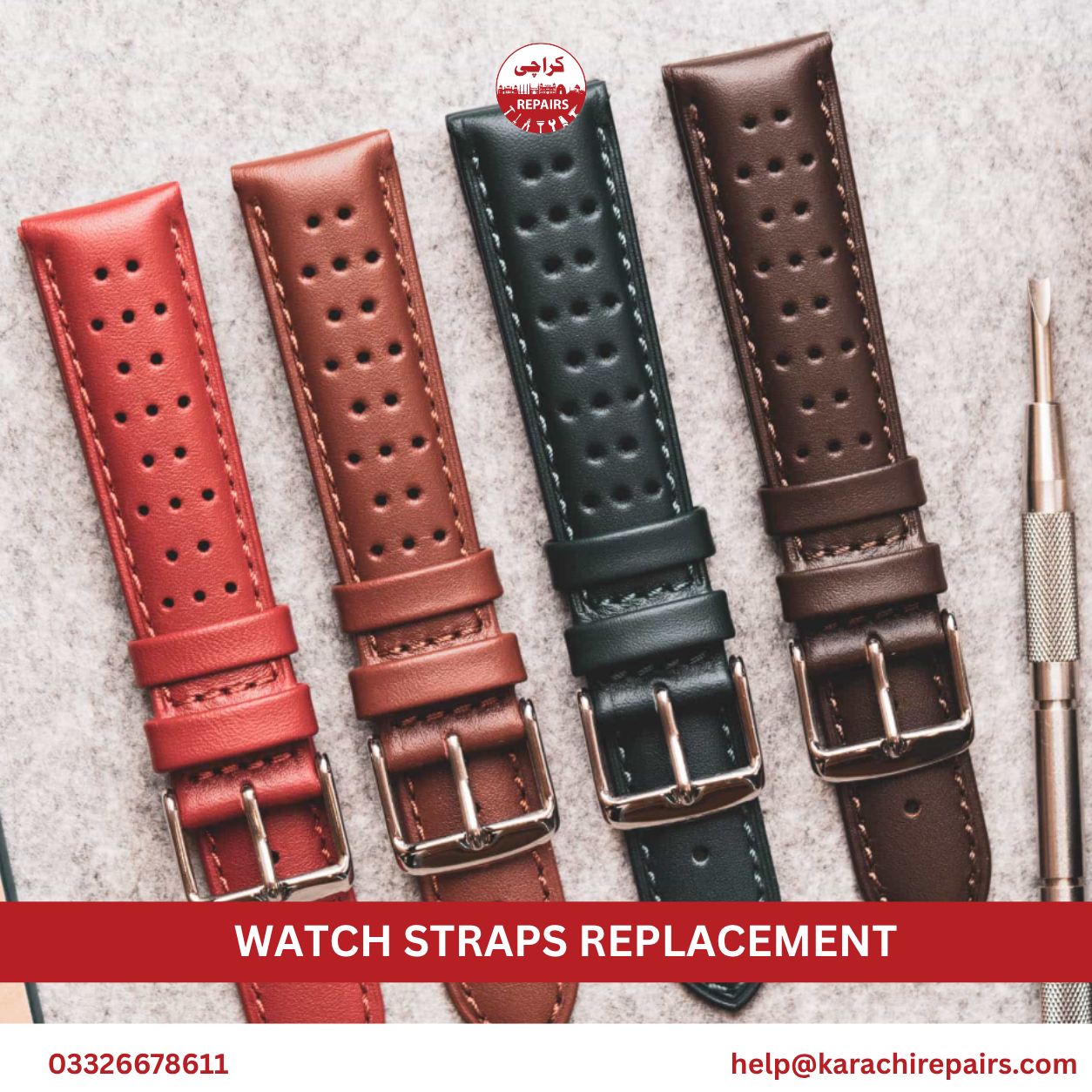
A worn-out, cracked, or broken watch strap is one of the most common reasons people stop wearing a watch they otherwise like. The movement inside might be running perfectly fine, but a peeling leather strap, a stretched metal bracelet, or a snapped spring bar makes the watch uncomfortable or embarrassing to wear. At Karachi Repairs, watch strap replacement is a service we handle constantly, covering everything from a simple leather strap swap to full metal bracelet resizing and specialty strap fittings for branded watches.
This page covers everything worth knowing about watch strap replacement in Karachi — the different strap types and materials, how the fitting process actually works, what affects sizing and pricing, and why something that looks like a two-minute job at a market stall can go wrong if it is not handled properly. This service is part of our broader Watch Repair department, so if your watch needs attention beyond the strap, that page covers our complete range of repair work.
Same-Day Response Watch Strap Service
Cracked leather, stretched metal bracelet, or a broken clasp? Tell us the address and the problem. Our technicians usually reach you within 1 to 2 hours anywhere in Karachi, seven days a week.
REQUEST A FREE VISIT


What Actually Happens
During Strap Replacement
Even something as seemingly simple as a strap swap has a correct way of being done, and cutting corners here leads to the same kind of avoidable problems seen with other rushed repairs.
1. Identifying Lug Width and Attachment Type: Every watch case has a specific lug width — the distance between the two points where the strap attaches — and using a strap that is even slightly the wrong width will either not fit at all or sit loosely with visible gaps. We measure this precisely rather than guessing based on what looks close.
2. Removing the Old Strap Safely: Spring bars connecting the strap to the case are released using a proper spring bar tool, which avoids scratching the case lugs — something that happens frequently when people try to pry a strap off with a knife or screwdriver at home.
3. Inspecting the Case Lugs and Spring Bars: Before fitting anything new, we check the condition of the lugs and spring bars themselves. Worn or bent spring bars are replaced rather than reused, since an old, fatigued spring bar is often what causes a seemingly well-fitted new strap to come loose unexpectedly later.
4. Fitting the New Strap or Bracelet: The new strap is attached using fresh spring bars sized correctly for the lug width, seated firmly so the strap sits centered and secure against the case. For metal bracelets, this stage also involves properly aligning the end links against the case for a flush, natural fit rather than a gap that looks obviously mismatched.
5. Sizing and Adjustment: For metal bracelets, links are removed or added to size the bracelet precisely to your wrist, with the pins reinserted securely. For leather and fabric straps, we confirm the buckle sits comfortably and the strap length works well for your wrist size, trimming or adjusting where needed.
6. Final Check: Before handing the watch back, we test the clasp or buckle function, confirm the strap sits securely with no wobble at the attachment points, and make sure the overall fit is comfortable and proportional to the watch case.
Strap Replacement for
Different Watch Types
Everyday Analog Watches: Usually straightforward, with standard lug widths that make sourcing a well-fitting replacement strap simple in most cases.
Dive and Sports Watches: Often benefit from rubber or silicone strap replacements that handle sweat and water exposure better than leather, particularly for anyone who wears their watch during exercise or outdoor activity.
Dress and Formal Watches: Typically paired with leather straps, where matching the original color, stitching style, and buckle finish matters for keeping the watch's overall look consistent.
Metal Bracelet Watches: Require careful link sizing and pin work, along with inspection of the clasp mechanism, which itself can wear out and need replacement or repair alongside the bracelet.
Branded and Luxury Watches: Often need manufacturer-specific straps or bracelets to maintain proper fit, finish, and in some cases resale value, which we source and fit with the same precision the original brand would apply.

How Much Does Watch Strap Replacement Cost?
Pricing depends on a handful of real factors rather than a single flat rate:
Material and Quality
Basic leather and fabric straps are generally the most affordable, with genuine leather, metal, and specialty materials costing more.
Bracelet Sizing Complexity
Metal bracelets requiring link removal, pin replacement, or clasp repair take more time than a simple strap swap.
Brand Requirements
Branded watches sometimes need manufacturer-specific straps or bracelets to maintain proper fit and appearance.
Spring Bar and Hardware
Fresh spring bars, pins, or a repaired clasp add slightly to the overall service where needed.
For an accurate quote for your specific watch, send us a photo on WhatsApp or call us directly at 0332 6678611, and we will confirm the price before any work begins.
Our Teams Across Karachi —
Doorstep Service Within 30 Minutes
What sets Karachi Repairs apart from a typical single-location repair shop is that we operate through technician teams positioned across different areas of the city. This means that wherever you are calling from — Clifton, DHA, Gulshan-e-Iqbal, North Nazimabad, PECHS, Gulistan-e-Johar, Malir, Korangi, Saddar, Nazimabad, or the surrounding neighborhoods — there is very likely a team close enough to reach you within roughly 30 minutes of your call.
A broken or worn-out strap is not usually urgent in the way a stopped movement might be, but it is genuinely inconvenient to keep wearing a watch that feels loose, uncomfortable, or embarrassing, or to leave a nice watch sitting in a drawer just because the strap has fallen apart. Instead of requiring a trip across the city, our area-based teams can reach your location the same day in most cases, carrying a range of common strap sizes and materials, so many replacements can be done on the spot during that same visit.
This same coverage extends across our full range of watch services, so whether it is the strap, the battery, the glass, or a movement issue, the same nearby team can typically handle everything without requiring a visit to a physical shop location.
Wide Range of Watch Repair Services
Twenty services covering everything from a hidden battery issue to a full watch movement replacement. All handled by our own trained technicians, anywhere in Karachi.
Watch Battery Replacement
Professional battery swaps for quartz, chronographs, and smartwatches.
Watch Glass Replacement
Replacing cracked or shattered crystals with perfect fit replacements.
Watch Strap Repair
Fitting new leather straps, steel bracelets, and rubber bands.
Watch Dial Replacement
Replacing discolored, cracked, or faded dials carefully.
Smartwatch Cell Replacement
Fixing degraded rechargeable smartwatch batteries safely.
Dive Watch Resealing
Replacing old gaskets to restore full water resistance.
Movement Cleaning
Removing dust and debris from intricate mechanical and quartz internals.
Coil Replacement
Fixing damaged circuits and coils that stop quartz watches from ticking.
Crown Repair
Fixing stiff or broken crowns and stems so you can set time again.
Dial Restoration
Cleaning faded or stained watch dials carefully to restore visibility.
Hand Alignment
Resetting hands that rub against each other or misalign with hour markers.
Rust & Corrosion Removal
Treating movements damaged by leaking old batteries.
Water Damage Repair
Drying and reviving watches that suffered sudden moisture intrusion.
Case Polishing
Buffing out deep scratches from steel, gold, and titanium cases.
Quartz Movement Swap
Replacing fully dead quartz mechanisms entirely when a battery won't do.
Link Removal
Sizing metal bracelets properly so the watch sits securely on your wrist.
Clasp Repair
Tightening or replacing loose folding clasps that pop open.
Vintage Watch Service
Extra care taken for older, delicate pieces requiring specific parts.
Digital Watch Repair
Reviving faded LCD displays and repairing sticky pushers.
Complete Overhaul
Full disassembly and inspection when the watch fails beyond simple swaps.
Why Karachi Repairs for Watch Strap Replacement
Strap replacement might look simple from the outside, but we apply the same care to it as any other watch repair, because a badly fitted strap affects both comfort and the safety of the watch itself:
Precise Measurement
Precise lug width measurement rather than guessing based on what looks close.
Proper Tools Used
Proper spring bar tools used to avoid scratching case lugs during removal and fitting.
Fresh Hardware
Fresh spring bars and pins fitted rather than reusing old, weakened hardware.
Careful Bracelet Sizing
Careful bracelet link sizing and end link alignment for a flush, natural fit.
Material Guidance
Material guidance based on how you actually wear and use your watch, not just like-for-like replacement.
Clear Price & Fast
Transparent pricing communicated before any work begins. Technician teams positioned across Karachi for fast response.
If your watch needs more than a strap replacement — a dead battery, a cracked crystal, a damaged dial, or a movement issue — our full Watch Repair service covers everything under one roof, and our technicians can assess the full scope of the issue in a single visit.
Common Myths About Watch Strap Replacement
A few misconceptions come up often enough that they are worth clearing up directly.
"Any strap that fits between the lugs will work fine."
Lug width matters, but so does the thickness and taper of the strap relative to the case design. A strap that technically fits the width but is too thick or thin for the lug opening can sit awkwardly, gap visibly, or put uneven pressure on the spring bars.
"Metal bracelets never need replacing."
While far more durable than leather, metal bracelets do wear over years of daily use, with individual links stretching at the pin holes and clasps weakening from repeated opening and closing. Eventually, a bracelet can develop enough play that it needs new links or a full replacement to sit properly again.
"A stiff or cracked rubber strap can be softened and reused."
Once rubber or silicone begins cracking from sun exposure and age, the material itself has degraded structurally. Softening agents might temporarily improve flexibility, but they do not reverse the underlying cracking, and the strap will continue to deteriorate.
"Strap replacement can be done with any strap..."
While this can work for basic, common lug widths, watches with unusual sizing, curved lugs, or proprietary attachment systems, especially many branded and luxury watches, often need a strap specifically compatible with that model to fit and sit correctly.
Why a Careless Strap Change Causes Problems Later
Strap replacement is often treated as the simplest possible watch repair, which is exactly why it gets rushed more than almost anything else.
Mistakes We Fix From Other Shops
A few recurring issues we see on watches that had strap work done elsewhere include:
Scratched Case Lugs
From prying the old strap off with the wrong tool instead of a proper spring bar tool.
Reused Old Spring Bars
Reused old, weakened spring bars that look fine but fail within weeks, causing the new strap to detach unexpectedly.
Wrong Lug Width Fitted
That leaves visible gaps on either side of the strap where it meets the case.
Poorly Aligned Bracelet End Links
That do not sit flush against the case, creating an awkward, uneven look.
Over-tightened or Loose Bracelet Pins
That either pinch the wrist uncomfortably or come loose after a short period of wear.
None of these mistakes are difficult to avoid with the right tools and a few extra minutes of care, which is exactly the standard we hold every strap replacement to, regardless of whether it is a basic leather strap or a full metal bracelet resize.
What to Do If Your Watch Strap Breaks
A few practical points if you are dealing with a worn or broken strap right now:
Simple Care Tips to Extend Strap Life
A few habits can noticeably extend how long a strap lasts before needing replacement:
Leather vs Metal vs Rubber: Choosing the Right Strap
When replacing a strap, it is often a good moment to reconsider whether the original material still suits how you actually wear and use the watch. Leather offers a classic, dressy appearance and tends to feel comfortable against the skin, but it demands more care, does not handle water well, and typically needs replacing more often, especially in Karachi's warm and humid climate where sweat exposure is a daily factor for most people.
Metal bracelets are considerably more durable and handle daily wear, water exposure, and general knocks far better over the long run, though they can feel heavier on the wrist and occasionally cause skin irritation for those with sensitive skin. Rubber and silicone straps are the most practical option for anyone active or regularly exposed to sweat and water, offering easy cleaning and strong durability, though they generally look more casual and are less suited to formal settings.
If you are unsure which direction makes sense for your lifestyle, we are happy to walk you through the trade-offs based on how you actually wear your watch day to day, rather than just replacing like-for-like out of habit.
Getting the Buckle and Clasp Right, Not Just the Strap
A strap replacement is not just about the material stretching between the two lugs. The buckle or clasp is just as important to the overall comfort and security of the watch, and it is often overlooked when people focus purely on the strap itself. A worn buckle pin can wear a hole into the strap unevenly over time, and a clasp with a weakened spring mechanism can pop open unexpectedly during normal wrist movement, which is exactly how watches end up falling off without the wearer noticing right away.
When we fit a new strap, we check the buckle or clasp condition as part of the same visit, rather than treating it as a separate issue the customer has to raise themselves. For metal bracelets specifically, the clasp mechanism sees more repeated stress than almost any other single component, opening and closing potentially dozens of times a week, so it is often the first part to show wear even while the links themselves still look fine.

Matching Strap Style to How You Actually Wear the Watch
It is worth thinking about your daily routine when choosing a replacement strap rather than automatically going back to whatever was originally fitted. If you wear the watch mostly for work in an office setting, a leather strap in a neutral tone usually complements formal and business-casual clothing well. If the watch comes off and on during exercise, sports, or frequent hand-washing throughout the day, a rubber, silicone, or metal option will hold up considerably better and requires far less maintenance.
Some customers also choose to keep two straps on hand for the same watch, switching between a formal leather option for work or events and a more casual rubber or fabric strap for weekends and physical activity. Since spring bars can be swapped relatively quickly once the correct size is confirmed, this is a practical way to get more versatility out of a single watch without needing multiple pieces, and we are happy to size a second strap for you during the same visit if that is something you are interested in.
Get Your Watch Strap Replaced Today
Whether it is a cracked leather strap, a stretched metal bracelet, or a spring bar that has become loose, Karachi Repairs is ready to fit a proper replacement that looks right and stays secure. Call or WhatsApp us at 0332 6678611, and one of our nearby technician teams will be with you shortly, usually within 30 minutes depending on your area in Karachi. For any other watch issues beyond the strap, visit our main Watch Repair page to see the full range of services we offer.
Frequently Asked Questions
The questions our Karachi customers ask most often, answered plainly.
How do I know what strap size my watch needs?
The lug width, measured in millimetres between the two points where the strap attaches to the case, determines the correct size. Most watches have this marked on the strap itself or the case back, but if you are unsure, send us a photo of your watch and we will confirm the exact size needed before fitting anything.
Can you replace just one section of a metal bracelet instead of the whole thing?
In many cases, yes. If only specific links or the clasp are worn or damaged, we can often replace just those components rather than the entire bracelet, provided matching parts are available for your specific watch model.
Will a new strap affect my watch's water resistance?
Generally no, since the strap itself is not part of the watch's water-sealed case. However, if the case back or crystal is opened during the same visit for another reason, we always check and reseal those separately to maintain proper water resistance.
How long does watch strap replacement take?
For standard strap swaps with common sizes, the replacement itself is quick. Metal bracelet sizing, clasp repairs, or sourcing a specialty strap for a branded watch may take slightly longer, and we will let you know upfront if extra time is needed.
Do you offer strap replacement at home or office?
Yes. Karachi Repairs has technician teams stationed across different areas of the city, and in most cases we can reach your location within roughly 30 minutes of your call, carrying common strap sizes and materials for on-the-spot replacement in many cases.
What strap material is best for daily wear in Karachi's climate?
For most people wearing a watch daily in Karachi's heat and humidity, metal bracelets or rubber and silicone straps tend to hold up better than leather, since they handle sweat and moisture exposure without breaking down as quickly. Leather remains a good choice for occasional or formal wear where comfort and appearance matter more than daily durability.
Can you source straps for branded watches with proprietary attachment systems?
In most cases, yes. For branded watches with specific attachment mechanisms, we work to source manufacturer-compatible straps or carefully adapted alternatives that fit securely without compromising the case or attachment points.
Areas We Cover
Across Karachi
Our technicians are spread across the city rather than run from one workshop, which is how same-day response stays possible in Karachi traffic.